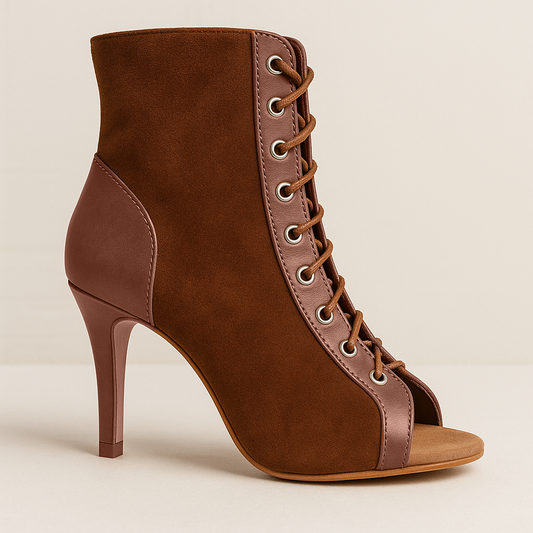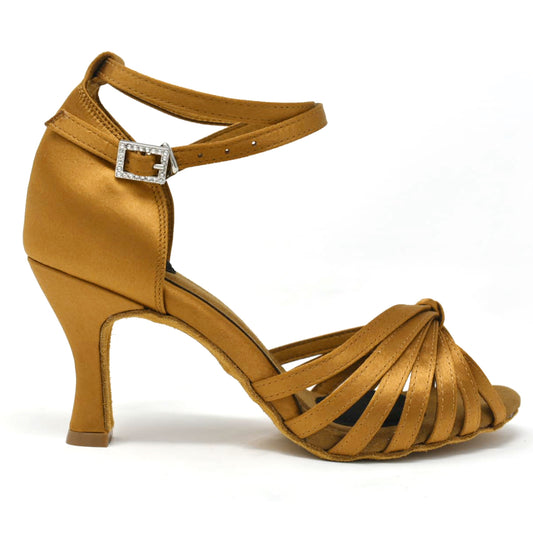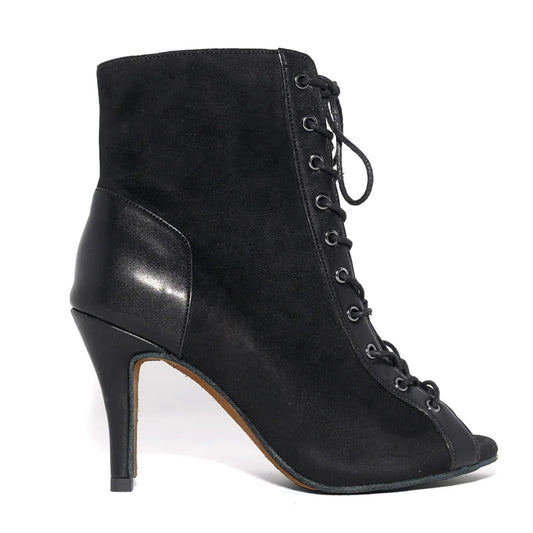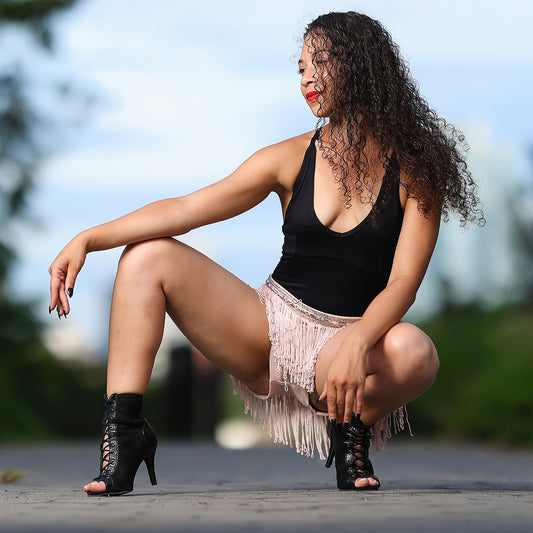

Most of us are not walking into dance class after a full day of rest.
We are closing our laptops, leaving the office, answering one last message, sitting in traffic, checking on our families, and trying to eat something before class begins. By the time the music starts, our feet may already have spent eight or ten hours inside another pair of shoes.
I am not a professional dancer. I am a woman who loves to dance.
Dance is where I challenge myself, meet people, improve my confidence, and remember that I am more than my responsibilities. Because dance matters to me, I want shoes that help me enjoy it—not shoes that make me count the minutes until I can take them off.
That is where full lace dance shoes can make a meaningful difference.
They give us more control over the fit of the upper shoe. That adjustability can be especially helpful when our forefeet are wide, our heels are narrow, our feet change during a long evening, or standard fixed straps never seem to fit quite right.
But full lacing is not magic. It cannot correct every sizing or comfort problem.
This guide explains what full lacing can adjust, what it cannot fix, and how to choose a shoe that supports your feet, your schedule, and your dancing goals.
The Quick Answer: Who Should Consider Full Lace Dance Shoes?
Full lace dance shoes may be a strong choice when:
- Your forefoot is wider than your heel.
- Standard straps feel too tight across one area and too loose across another.
- Your feet feel fuller later in the day.
- Your heel or midfoot moves inside regular dance shoes.
- You want to adjust the fit during a long class or social.
- You prefer a bootie or cage-style shoe that surrounds more of the foot.
- You want a secure feeling without depending on one ankle strap.
They may not solve the problem when:
- The shoe is too short.
- The sole platform is narrower than your foot.
- The heel cup is much too large.
- The heel height is beyond your current comfort or stability level.
- The outsole is unsuitable for the floor.
- You must pull the laces painfully tight to keep the shoe in place.
The goal is not to force your foot into a shoe. The goal is to choose the right shoe and then use the laces to refine the fit.
What Are Full Lace Dance Shoes?

Full lace dance shoes use laces across a significant portion of the upper instead of relying only on a fixed toe strap and ankle buckle.
Depending on the design, the lacing may let you adjust:
- The space across the toes
- The pressure around the ball of the foot
- The fit over the instep
- The containment through the midfoot
- The security around the ankle
This matters because two women can wear the same shoe size and still have completely different feet.
One may have a wider forefoot and narrow heel. Another may have a slim forefoot but a high instep. Another may find that her shoes fit perfectly at 6:00 p.m. but feel noticeably tighter at 10:00 p.m.
A standard size number tells us something about length. It does not describe every part of our foot.
Full lacing gives us more ways to respond to those differences.
Why Full Lace Dance Shoes Can Help Wide Feet

Women with wider feet are often told to simply buy a larger size.
Sometimes going up half a size is appropriate. But sizing up only to create width can also make the shoe too long. That extra length may allow the foot to slide forward, cause the heel to lift, or place the ball of the foot in the wrong area of the shoe.
A full-lace design may offer another option.
You can leave more room through the lower lacing area while securing the shoe more firmly around the instep and ankle. This is particularly useful when your forefoot is wide but the rest of your foot is not.
For example:
- Loosen the laces slightly across the ball of the foot.
- Keep moderate tension over the midfoot.
- Secure the upper section enough to reduce heel movement.
- Stand and test the shoe before deciding it is too loose.
Yami’s Puchi line uses a full lace-up design intended to allow width adjustments and accommodate changes in foot volume. It also includes an elastic front and street-friendly outsole in selected versions.
However, even the best dance shoes for wide feet must have a sole platform that supports the foot.
If the sides of your forefoot extend beyond the base of the shoe, loosening the laces will not make that base wider. You may need another model, a wider toe-box shape, or a TrueFit design.
Why Full Lace Dance Shoes Can Also Help Narrow Feet

Full lacing is not only for wide feet.
Women with narrow or low-volume feet often have a different problem: there is too much space inside the shoe.
You may notice:
- Your forefoot moving from side to side
- Your foot sliding toward the toes
- The upper material folding excessively
- Your heel lifting when you step
- The shoe feeling disconnected from your movement
With full lace dance shoes, you can draw the upper closer around the foot in stages instead of depending on one strap to do everything.
Start at the lower laces and work upward gradually. Do not immediately pull the ankle area as tightly as possible. The shoe should feel connected to your foot without cutting into your skin or restricting normal movement.
Full lacing may be especially useful when you have:
- A narrow forefoot
- A low instep
- A narrow heel
- A foot that is narrow in one area but average in another
The important limitation is the heel cup. If the back of the shoe is much wider than your heel, tightening the front may not eliminate heel movement. In that case, another model may provide better heel containment.
Wide vs. Narrow Dance Shoes—How to Know What You Actually Need
What About Feet That Swell During a Long Dance Night?

Many working women arrive at dance after spending most of the day sitting, standing, commuting, or walking.
Even when our shoes fit well at the beginning of the evening, our feet may feel different after several hours of movement. That does not mean we should begin the night in shoes that are already loose. It means adjustability can be valuable.
One of the practical benefits of lace-up dance heels is the ability to make small changes during the evening.
You may:
- Begin with the shoe securely laced.
- Dance through class or the first part of the social.
- Stop if you feel increasing pressure or tingling.
- Loosen only the section that feels restrictive.
- Keep the midfoot and ankle secure.
- Retest the shoe before returning to the floor.
Do not continue dancing through numbness, sharp pain, burning, or a sudden change in one foot. Persistent, severe, or one-sided swelling should be discussed with a qualified healthcare professional.
The objective is not to ignore what your body is telling you. The objective is to have enough adjustability to respond before discomfort takes over your evening.
Full Lace vs. TrueFit vs. Traditional Strappy Heels

Yami offers more than one approach to adjustable fit.
| Feature | Full-lace design | TrueFit adjustable toe box |
Traditional strappy heel |
| Main adjustment area | Forefoot, instep, midfoot, and sometimes ankle | Primarily the forefoot and toe-box area | Usually the ankle strap |
| Best for | Overall foot-volume adjustment | Targeted front-of-foot adjustment | Feet that already match the shoe shape |
| Wide forefoot | Often helpful | Often helpful | Depends strongly on the model |
| Narrow or low-volume foot | Often helpful | May help at the forefoot | Limited adjustment |
| Adjustment during a social | High | High at the front | Usually limited |
| Time to put on | Usually longest | Moderate | Usually fastest |
| Main limitation | Cannot correct wrong length or sole width | Does not adjust every part of the upper | Fewer ways to customize the fit |
TrueFit uses an adjustable buckle toe-box strap designed to customize the forefoot fit for narrower or wider feet. The current TrueFit collection also emphasizes Yami’s padded insoles and stable heel construction.
- Choose full lace when you want to adjust several areas of the upper.
- Choose TrueFit when your primary concern is the toe box or forefoot.
- Choose a traditional strappy heel when the standard shoe shape already matches your foot and you prefer a faster, simpler closure.
TrueFit Adjustable Dance Shoes collection
What Full Lacing Cannot Fix

This may be the most important part of the guide.
Because full lacing is so adjustable, it can be tempting to keep changing the laces instead of admitting that the shoe itself is wrong.
A Shoe That Is Too Short
If your toes are compressed against the front, curling under, or experiencing sharp pressure, loosening the laces will not add length.
A Shoe That Is Too Long
If your foot slides forward and leaves unnecessary space behind the heel, tightening the laces may only mask the problem.
A Sole That Is Too Narrow
The base of the shoe must support your foot. Your forefoot should not feel as though it is spilling significantly beyond the platform.
A Heel Cup That Does Not Match Your Heel
A very loose heel cup may continue to move even when the front of the shoe is tightly secured.
The Wrong Heel Height
A four-inch heel does not become a beginner heel because it has laces.
A 2023 systematic review and meta-analysis of 81 studies found that high-heeled shoes shift plantar pressure toward the forefoot and affect balance compared with flat shoes or barefoot conditions. That research examined walking rather than social dancing, but it reinforces the importance of matching heel height and base to your current ability and comfort.
The Wrong Outsole
“Full lace” describes the upper. It does not tell you whether the bottom is suede, rubber, or another street-friendly material.
The upper must fit your foot, and the outsole must fit your floor.
How to Try On and Lace Full Lace Dance Shoes

Use this process on a clean indoor surface so the shoes remain eligible for exchange.
Step 1: Measure Both Feet
Measure both feet near the end of the day. Use the longer foot as your starting point.
Do not assume your right and left feet are identical.
Step 2: Loosen the Entire Upper
Do not force your foot into a tightly laced shoe. Open the laces enough for your heel to settle fully into the back.
Step 3: Adjust From the Forefoot Upward
Begin near the toes and work upward.
The lower section should feel comfortably contained—not crushed. The midfoot should feel secure. The upper section should reduce unnecessary movement without digging into the ankle.
Step 4: Stand Before Judging
Your foot spreads when it carries your body weight.
A shoe that feels roomy while sitting may feel correct when standing. A shoe that feels tight while sitting may become too restrictive once you stand.
Step 5: Test Dance Movements
Try:
- Slow weight changes
- Side steps
- Forward and backward basics
- A controlled pivot
- Pointing the foot
- Rising onto the ball of the foot
- A few gentle turns
Pay attention to heel movement, toe pressure, forward sliding, and whether the laces stay secure.
Step 6: Test Again Later
Do not wait until an important event to discover that the fit changes after an hour.
Wear the shoes during a short practice at home on an appropriate clean surface before using them for an entire social.
Yami Fitting Guide
Yami Size Chart
Choose the Sole for the Life You Actually Live
As a working woman, I do not choose shoes only by how they look in a studio photograph.
I think about where I am going, how much walking I will do, whether I can change shoes, what the floor may be like, and how long I expect to dance.
Choose a Street-Sole Full-Lace Shoe When:

- You may walk between your car, restaurant, and venue.
- The event includes indoor and outdoor areas.
- You dance at clubs, patios, festivals, or mixed-floor socials.
- You do not want to carry a second pair.
- You want the option to style the shoe beyond the dance floor.
Yami styles such as Amanda, Celia, Lucila, Puchi, and Yashira combine adjustable lace-up uppers with street-friendly outsoles in selected versions. Product details vary, so the exact outsole and heel option should be checked before ordering.
Choose a Suede-Sole Full-Lace Shoe When:

- You dance primarily on clean indoor wood floors.
- You want the traditional glide and floor connection of suede.
- You are willing to change shoes before and after dancing.
- Your training or performance requires a specialized indoor sole.
Never assume that two lace-up shoes will feel the same simply because their uppers look similar. The sole changes the experience.
Street Sole vs. Suede Sole—The Complete Surface Guide
Which Yami Full-Lace Style Fits Your Routine?
The best model depends on your life—not only your favorite color.
For the Woman Going From Work to a Social
Consider a street-sole bootie with a zipper and lacing.
The zipper makes changing easier, while the laces let you refine the fit. Celia, for example, uses a full lace-up design, elastic at the toe area, a back zipper, and a rubber street sole.
For the Woman Who Wants Maximum Width Adjustment
Consider Puchi or another full-lace design with an elastic front.
The Puchi catalog description specifically highlights width adjustment, accommodation for changing foot volume, padding under the balls and heels, and street-friendly construction in selected styles.
For the Woman Who Wants an Open, Fashion-Forward Look
Consider Lucila or another open-toe lace-up design.
Lucila combines an adjustable lace-up closure, open-toe styling, street sole, and Yami cushioning under the ball and heel.
For the Woman Who Wants More Coverage
Consider a closed-toe lace-up bootie.
Aaliyah, for example, combines a closed toe, full lacing, zipper, street sole, and a four-inch stiletto. That height makes it a more specialized choice, so the heel should match your experience—not only your outfit.
For the Woman Who Wants a Lower, More Stable Heel
Filter first by heel height and shape.
A lower or flared heel may be more practical for long socials, newer heel dancers, or anyone prioritizing a broader base. Do not choose the highest heel because it looks aspirational. Choose the heel that allows you to dance with control.
Comfort Is Not the Opposite of Ambition
There is a belief in dance that discomfort proves commitment.
I do not believe that.
You can work hard, challenge your balance, improve your technique, and chase ambitious dance goals without treating pain as a requirement.
Research on heeled footwear suggests that heel height, heel-base size, and insole design can influence pressure, stability, and perceived comfort. The available research has limitations and is not specific to every style of dance, but it supports a practical conclusion: shoe construction matters.
Yami’s current website emphasizes extra padding under the balls of the feet and heels across its footwear lines. That padding is intended to address two areas that often feel the most pressure during extended wear.
Padding, however, cannot replace correct sizing, appropriate heel height, and a secure fit. Comfort is a combination of all of them.
Frequently Asked Questions About Full Lace Dance Shoes
Should I Size Up for Wide Feet?
Not automatically.
If the problem is upper volume, the laces may create enough room without adding length. If the sole or toe shape is too narrow, another size or model may be necessary.
Are Full Lace Dance Shoes Good for Narrow Feet?
They can be. Full lacing can reduce extra space across the forefoot, instep, and midfoot. The heel cup must still fit securely.
Can Full Lacing Stop My Heel From Slipping?
It may reduce movement when the shoe is the correct length and the heel cup is reasonably close to your heel. It cannot fully correct a heel cup that is much too large.
Can I Loosen My Shoes During a Social?
Yes. Small adjustments are one of the main benefits. Loosen only the area that feels restrictive while keeping the shoe secure elsewhere.
Are All Full-Lace Shoes Suitable Outdoors?
No. Check the outsole. A full-lace upper can be paired with suede, rubber, or another type of sole.
Are Full-Lace Shoes Better Than TrueFit?
Neither is universally better.
Full lace offers adjustment across more areas. TrueFit offers targeted forefoot adjustment. Your foot shape determines which system makes more sense.
Should Dance Shoes Feel Tight?
They should feel secure and responsive, but not painfully tight. Numbness, sharp pressure, burning, or toe curling are warning signs—not proof of a proper dance fit.
Choose Shoes That Support the Woman You Are Becoming
You do not have to be a professional dancer to take your dancing seriously.
You can have a career, a family, bills, responsibilities, and a long list of things waiting for you tomorrow—and still care deeply about improving your Salsa, feeling more confident in Bachata, performing with your team, or simply staying on the floor for one more song.
The right full lace dance shoes should support that life.
Choose the correct length. Respect the width of your foot. Select a heel you can control. Match the outsole to the floor. Use the laces to refine the fit—not to force the wrong shoe to work.
Your dreams do not become less important because you pursue them after work.
Explore Yami’s Full Lace-Up Dance Shoe collection and find a shoe that adjusts to your feet, your schedule, and the way you want to move.
Shop Full Lace-Up Dance Shoes
Explore TrueFit Adjustable Dance Shoes
Read the Yami Fit Guide